In 1939, the Electro-Mechanical Division (EMD)
of General Motors challenged the steam locomotive in what many
thought was an impossible battle, the hauling of huge loads of
freight. The diesel had proven itself to some skeptics as a capable
passenger locomotive, but many doubted that it could pull freight
as well. Those doubters were in for quite a shock.
In an 11 month tour of 35 states and 20 Class 1 railroads, EMD
FT (The F for freight and the T for 2700 horsepower with a 2 unit
set) unit demonstrators #103A, 103, and 2 boosters, dealt a deathblow
to the steam locomotive. The "bulldog" F proved it could
pull freight well and beat the steam locomotive in efficiency
in almost every category. The F could haul more freight, with
less fuel, than a steamer. Diesels could be arranged in a "building-block"
fashion, the number of units adjusted for the horsepower needed.
In addition, a "lash-up" of diesels, thanks to MU controls,
could be run by a single crew in one cab, greatly cutting down
on labor cost. Maintenance requirements were much lower and railroads
could dispense with the costly coaling and water facilities needed
by steam locomotives. Over the next 6 years, 1096 FTs were built.
One railroad, Santa Fe, purchased 320 units! Santa Fe operated
rather extensively in desert territory, where water for steamers
was hard to come by, therefore it saw the advantages of diesel
power. It is not an exaggeration to say that the FT, along with
later F models, almost single-handidly ended over 100 years of
steam dominance on the tracks.
In all, over 7600 F units (both A units and boosters) were built
between 1939-1960. The FT was followed by the F2, F3, F7, FP7,
F9, FP9, and production ended in 1960 with the FL9. The F was
easily the top selling cab unit of all time.
F Unit Technical Data: (F7)
Model: F7
Horsepower: 1500
Tractive Effort: 57,500lbs.
Engine: EMD 567B
16 Cylinders
Units Sold:
2366 (A units)
1483 (B units)
Total: 3849
Produced: 1949-1953
F unit models: FT, F2, F3, F7, FP7, F9, FP9,
FL9
(and B units)
A units: 4708
B units: 2904
Total: 7612
Technical Features:
1. Most F units were almost 51 feet long and
weighed 230,000 pounds. The A unit was 15 feet high and 10 and-a-half
feet wide. The F7 had a tractive effort of 57,500 lbs.
2. Horsepower eventually reached 1800 with the FL9.
3. The truck design was BO-BO.
4. Normal maximum speed was 65 m.p.h. on a standard gear ratio
of 62:15. A ratio of 65:12 allowed 55 m.p.h., 71 m.p.h. on 61:16,
77 m.p.h. on 60:17, 83 m.p.h. on 59:18, 89 m.p.h. on 58:19, 95
m.p.h. on 57:20, and 102 m.p.h. on 56:21.
5. Although designed for freight, the F was quite suitable as
a passenger hauler. Many units were fitted with steam boilers
for this purpose. The higher tractive effort of the F, in comparison
to the E, and better adhesion on flat terrain, made it attractive
to companies that did not operate in areas with steep grades.
Santa Fe used Fs to pull one of the finest passenger trains ever,
the Super Chief.
6. The F carried 1200 gallons of fuel oil. In addition, 200 gallons
of lubricating oil was carried, 230 gallons of cooling water,
and over 1000 gallons of water could be carried for the steam
generator.
7. The original model, the FT, was designed to operate in sets
that were semi-permanently coupled with drawbars. This inflexible
arrangement was unacceptable to railroads and EMD was forced to
re-design the FT and later models with standard couplers.
8. The FP7 and FP9 models (The P for Passenger) were also offered
by EMD. These units were 4 feet longer than the standard F and
this additional space was used for more water tanks to supply
the steam generator.
9. Dynamic braking was optional.
10. Most F units served 15 years or more before being retired.
The FL9: A 5 axle F
The FL9 was the final variant of the F unit.
It arose because of a need by the New Haven Railroad (and others)
for a dual-mode locomotive that could be powered by either an
internal diesel engine, or from a third rail carrying electricity.
New Haven operated passenger trains in New York City and other
nearby cities. Many cities had laws that banned smoke emissions
within city limits. The only way for a train to operate was to
be able to switch to third rail power once it neared the city
limits. Before the diesel, steamers had pulled passenger trains
part of the way and then were replaced by electric locomotives
for the remainder of the journey. The FL9 was designed to do both
these jobs with one locomotive.
The FL9 was fitted with the EMD 567C or 567DI engine, generating
1750 and 1800 hp, respectively. An extra axle was added on the
rear trucks to more evenly distribute the weight of the unit and
contain the third rail shoes. When called upon, the shoes deployed
and contacted the third rail. This powered the traction motors
instead of the diesel engine. New Haven, Penn Central, the Metropolitan
Transportation Authority, Conrail, Amtrak, and the Connecticut
Department of Transportation, owned and operated the FL9. FL9s
were 4 feet longer than the FP7 and 8 feet longer than the standard
F. A total of 60 FL9s were built. Most of them still exist, either
in operation or in storage. The recent arrival of the GE P-32
dual-mode Genesis units may mean the days of the FL9 are numbered.
Historical Perspective:
The F unit has been referred to as "the
diesel that did it" by the editor of Trains magazine. The
F unit changed an entire industry almost beyond recognition. Who
could have guessed that the humble F unit would play a large role
in the demise of the steam locomotive in less than 20 years?
The F also established EMD as the leader in diesel locomotive
construction for nearly 50 years. Only recently has EMD slipped
to second place behind GE. Over 7000 F units were sold. The F
outsold the FA, its closest competitor, by almost 6 to 1. It was
no contest.
Survivors:
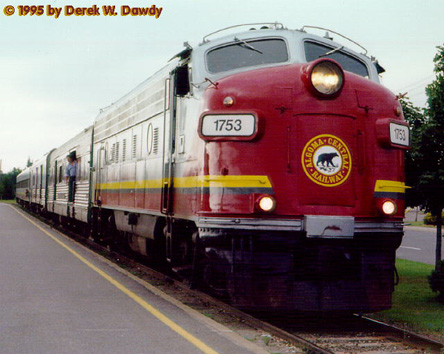
About 250 F units still exist across North America. Some pull excursion and dinner trains, others sit as static displays in museums, while some await a rebuilding and return to service. A few even still serve in mainline freight and passenger service. They are out there.
Railfan Perspective:
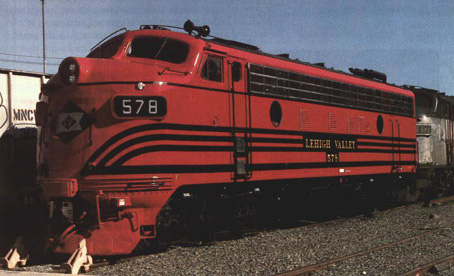
The F has become one of the all time favorites
of the railfan. The attractive, bull-dog nose and fine lines have
come to represent the diesel locomotive itself. So many Fs were
built that they showed up in every part of the country and became
a common sight to millions of people. Many have survived far longer
than designed. The F helped usher in the era of the colorful railroad,
with countless paint schemes and variety. This contrasted sharply
with the almost uniform black or gray of the steam locomotive.
The image of the vibrant railroad, ready to meet the challenges
of the 20th Century and beyond, was created. And that image is
still with us.
|
|
|
|
|
|
|
|
|
|
|
|
|
|
|
|
|
|
|
|
|
|
|
|
|
|