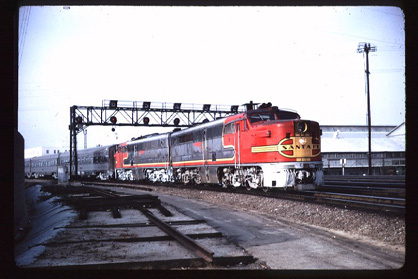
On September of 1946, in an elaborate ceremony at the Alco plant at Schenectady, New York, a shiny new diesel passenger locomotive was revealed to the world. It was the first production-run version of the PA-1. (The P for passenger, the A for a cab unit, and the 1 for the first model) Gleaming in the beautiful red-silver-yellow Santa Fe warbonnet paint, it was quite a sight. It was soon joined by another cab unit and a booster. Over the next few days, a very elaborate PR campaign was launched with a news broadcast from the cab of PA#51 and even a desert scene was created around the locomotive to highlight the type of terrain the new diesel would encounter under the Santa Fe flag. This flush of post-war optimism began an era that Alco hoped would bring a huge surge of locomotive orders and prosperity to the old company.
PA Technical Data(Numbers may vary depending on source)
Model: PA-1/PB-1
Horsepower: 2000
Engine: Alco 244
16 cylinders
Produced: 1946-50
Units sold: 170 (PA-1)
40 (PB-1)
Total built: 297
A units: 250
B units: 47 Model: PA-2/PB-2 PA-3/PB-3
Horsepower: 2250
Engine: Alco 244
16 cylinders
Produced: (Model 2) 1950-1952
(Model 3) 1952-1953)
Units sold: 31(PA-2) 2(PB-2)
49 (PA-3) 5(PB-3)
Maximum Speed: 102 m.p.h./standard
gear ratio of 64:23. 80 m.p.h. at ratio of 64:19,
92 m.p.h. at 62:21, 104 m.p.h. at 60:23, and
117 m.p.h. at 58:25.
Technical Features:
1. The PA was 65 feet long, 14 feet high, and almost 11 feet wide.
The trucks over 15 feet long and arranged in the A-1-A configuration.
The center wheel on both trucks was unpowered and distributed
the weight of the locomotive more evenly on the track. This also
provided a smoother ride.
2. The very powerful 244 engine with 16 cylinders generated 2000
horsepower. The EMD equivalent to the PA, the E unit, required
2 engines to develop the same horsepower.
3. The engine was also fuel-injected and turbocharged.
4. The very sophisticated Amplidyne generator excitation system
was used to provide precise control of the output of the main
generator. This allowed, for the first time in a locomotive, the
use of circuit breakers instead of fuses. This feature was much
appreciated by train crews.
5. Dynamic braking was an optional installment.
6. Of the PA-1s 306,000lb weight, about 204,000lbs was carried
on the driving wheels.
7. Each A unit could carry over 1200 gallons of fuel oil and 1000
gallons of fuel for the steam boiler(for heating passenger cars)
and 300 gallons for engine cooling. In addition, 230 gallons of
oil was carried for the lubrication of engine parts.
8. Sand was also carried to be used to reduce wheel slippage on
difficult or slippery track.
9. Most of the components of the PA were fully compatible with
the Alco FA locomotive.
PA Historical Analysis:
The PA, unfortunately, did not live up to the expectations of Alco. Production only lasted 7 years and the total number of units built, including boosters, was only 297. This compared poorly with the 1300 E units sold by EMD. Most PAs lived out the average life span of a diesel cab unit of 15 years. Many were regeared and used for freight service late in their careers. Santa Fe used some of its PAs for more than 20 years. Most PAs were gone by the late sixties.
Possible reasons for poor PA sales:
1. EMD market dominance. GM was a powerhouse in diesel construction
and held 90% of the market in some years. The best Alco could
do was hit 40% on occasion.
2. EMD usually beat Alco in the race to develop new diesel models.
The E unit first appeared in 1937 and proved itself a reliable
locomotive. The first PA was not ready until 1946.
4. The PA suffered some early technical problems with the Amplidyne
system that took some time to work out.
5. For an unknown reason, the PA required more maintenance than
an E unit. This is surprising since the PA had only 1 engine instead
of the 2 EMD put in the E.
6. The 244 engine was rushed into service by Alco and had more
problems as a result.
7. During World War II, the war production board restricted locomotive
construction and assigned certain types of locomotives to be built
by certain builders. Alco was forced to concentrate on both diesel
and steam switchers and was not allowed to build cab units.
8. Diesels built by different companies required different types
of spare parts. Therefore, it was cheaper for many railroads to
stick with one diesel builder. (EMD usually)
A Railfan Perspective:
From the viewpoint of the railfan, the Alco PA will always be
considered one of the best looking, if not the best, diesel locomotive.
That long nose accounts for much of the allure of the PA. It was
in stark contrast to the short, bulldog nose of the E unit. The
carbody was also well proportioned and graceful.
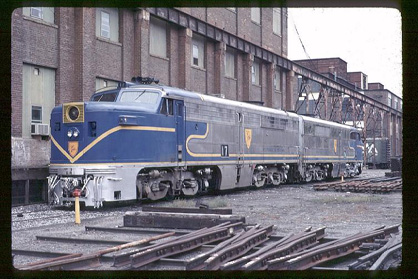
Many different paint schemes adorned the PA. Some of the best
included the colors of the Santa Fe, Delaware and Hudson, Rio
Grande, Erie-Lackawanna, Lehigh Valley,Nickel Plate, New York
Central, Southern Pacific, and Wabash. The warbonnet of the Santa
Fe, of course, was widely considered the greatest and seemed to
bring out the best in the PA.
Survivors:
It is very sad that the most beautiful diesel locomotive ever
built was not preserved well. Of 250 cab units built, only 7 are
currently known to exist. Three PA-2s were sold to the Brazilian
National Railway and all 3 remain. One is in decent condition
at the Museum of History & Culture in Brazil, while the other
two units rust away in a backlot. There are currently no plans
to restore these units and return them to the U.S. In 1967, Santa
Fe sold 4 PAs to the Delaware and Hudson Railroad. They were rebuilt
and used to power commuter trains and special excursions. In 1978
the 4 units were leased and later sold to the National Railway
of Mexico. Eventually D&H #17&19 (they still used the
D&H numbers) were placed in museums in Mexico. Although they
are in operational condition, it is unlikely they will run again.
Number 16 and 18, however still exist as wrecked hulks. They could
be restored to service with a lot of work. These two units finally
returned to the U.S. in 2000. Number 18 will be rebuilt and used
for excursion service as NKP #190, while #16 will be cosmetically
restored in ATSF warbonnet and displayed at the Smithsonian. These
two "incredible hulks" will be exciting to see when
they are finished!
In addition, one B unit still exists as heater car #252. (Former
Rio Grande 6012)
The PA has gone on to achieve a legendary fame
in railfan circles. Because of it's tendency to belch heavy, black
smoke, the PA has even been declared to be an "honorary steam
locomotive". Even the late, noted train artist Howard Fogg,
a big steam aficionado, once called the PA "a nice looking
locomotive". What else needs to be said?
|
|
|
|
|
|
|
|
|
|
|
|
| "PA: Alco's Glamour Girl" Andy Romano. Four Ways West Pub. 1997 |
|
|
|
|
|
|
|
|
|
|
|
|
|
|